Why is Seibu on Ikebukuro’s east side and Tobu on the west?
Two railways arrived on opposite sides of Ikebukuro Station. Five department stores followed. How did a transfer stop become a commercial centre?

Orientation diagram, not to scale.
The stations came before the names
Tojo Railway ran from the west side of Ikebukuro towards Kawagoe. Musashino Railway ran from the east side to Hanno. Each had its own company and station. The companies later merged with other railways and changed names, while their positions on either side of the station held.
West exit
- Tojo Railway opens on the west side
- Joins Tobu Railway as the Tojo Line
East exit
- Musashino Railway opens on the east side
- Takes the Seibu Railway name after merging with the former Seibu Railway
Five department stores around one station
Seibu’s predecessor, Kikuya, opened on the east side in 1935. Tokoyoko was first to open on the west side in 1950. Tokyo Marubutsu and Mitsukoshi followed on the east. When Tobu opened in 1962, five department stores stood around the station. Commuters could shop on their way home, and shopping itself became a reason to get off at Ikebukuro.
West exit
- Tobu Department Store
- Tokoyoko
East exit
- Seibu Department Store
- Tokyo Marubutsu
- Mitsukoshi
On the west side, Tobu acquired neighbouring Tokoyoko and built a 15-storey department store on the site in 1971.
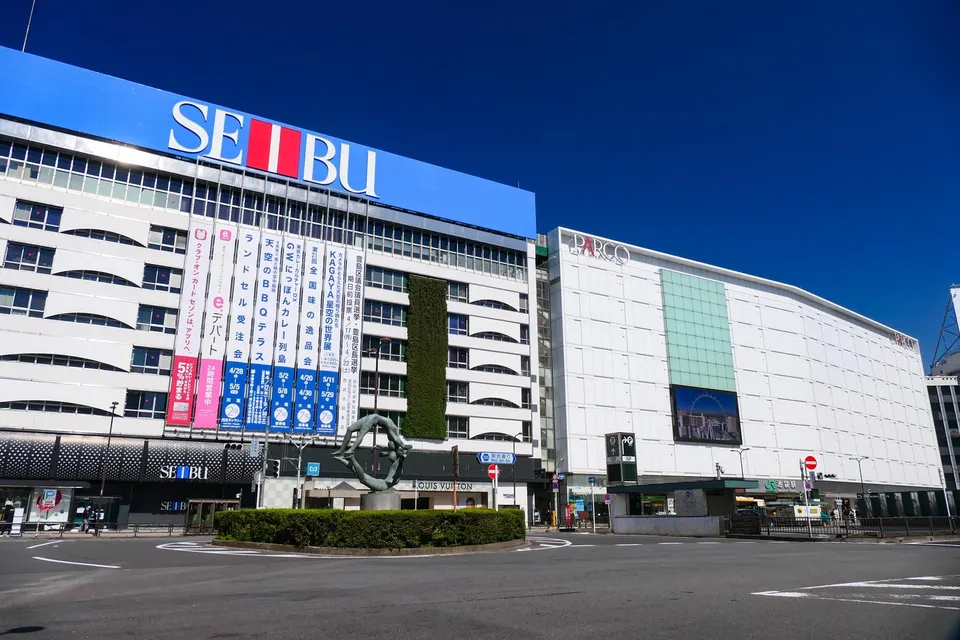
On the east side, Tokyo Marubutsu became Ikebukuro PARCO in 1969, giving fashion and youth culture a home of their own. Seibu later opened an art museum inside its department store, where shoppers could see modern art exhibitions.
Seibu Department Store and Seibu Railway are now run by separate companies. In 2023, Seven & i transferred Sogo & Seibu to an affiliate of Fortress.
Foot traffic moves beyond the station
Ikebukuro was once nicknamed Ekibukuro, a pun on the Japanese word for station. The station and department stores were busy, but shoppers seldom ventured much farther. When Sunshine City opened in 1978, its shops, aquarium, theatre and observatory gave people a reason to walk deeper into east Ikebukuro.
From the west exit to Sunshine City
- Tobu Department Store
Look back from the west plaza. The department store and the Tobu Tojo Line entrance are on the same side.
- Ikebukuro Station
Cross the station concourse and follow signs for the east exit.
- Ikebukuro PARCO
Look back from the east exit. Seibu stands beside PARCO, the former Tokyo Marubutsu.
- Sunshine City
Walk east along Sunshine 60 Street to see how shopping spreads from the station into the neighbourhood.